Drone Roof Survey Every Slope, Close Up
No ladders on the tiles, no scaffold, no roofer with a reason to find work. A sub-250g drone photographs every slope, hip, valley, ridge and chimney at two to four metres, including the rear faces and back gutters that nobody has looked at since the house was built. Graded defect schedule in 48 hours for £199, and a pole camera where the airspace says no.
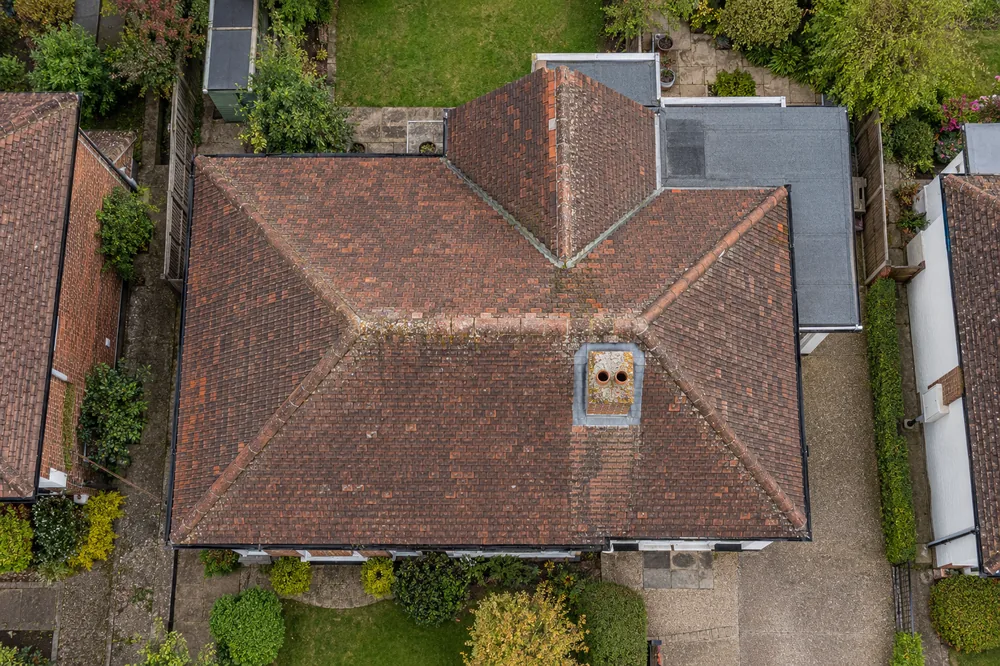
Drone Roof Survey explained
A drone roof survey is a close-range photographic inspection of a roof from the air by a CAA-registered operator. It captures every slope, chimney, valley and flashing without anyone climbing onto the covering. The Drone Roof Report costs £199, includes a graded defect schedule with 25 or more numbered photographs, and is issued within 48 hours.
Last reviewed by Matt Novell
- How does a drone roof survey work?
- What can a drone see that a ground inspection cannot?
- Can you fly a drone near Farnborough, Odiham, Blackbushe or Heathrow?
- What are the legal and insurance requirements for drone roof surveys?
- What is in the £199 Drone Roof Report?
- How do I prepare for a drone roof survey?
How does a drone roof survey work?
We fly a sub-250g drone from the garden or pavement, first at 15 to 20 metres to map the whole roof, then at 2 to 4 metres above each surface to photograph tiles, mortar, lead and junctions individually. Chimneys are orbited. The flight takes 15 to 30 minutes, nothing touches the roof and nobody needs to be home.
The mapping pass produces the plan view that becomes the numbered roof plan in your report. The close pass produces the evidence. At 3 metres a 12-megapixel sensor resolves a hairline crack in a concrete tile, the gap where a slate nail has rusted through, the open joint in a mortar bedded ridge, and the pinholes in a lead flashing that has been patched with sealant. Those are the defects that a ground-level look with binoculars misses and a roofer on a ladder only sees on the slope they happen to be standing on.
The drone also sees what nobody else does: the back of the chimney stack, the hidden valley between a main roof and a rear addition, the top of a bay window roof, the flat roof over a two-storey extension, and the parapet gutters on an Edwardian villa. Most undisclosed roof problems on older houses are on surfaces that are invisible from the ground and awkward to reach by ladder.
Flights are planned before we arrive. We check the airspace, the forecast wind, the position of trees and overhead lines and the neighbouring properties. We do not fly in rain, in winds above about 20 mph, or when visibility is poor, because the photographs would not be good enough and the report would be worse for it.
What can a drone see that a ground inspection cannot?
From the ground, a surveyor sees the front slope at an oblique angle and guesses the rest. From the air, every slope is seen square-on at close range. Rear slopes, valleys, hips, the top courses under the ridge, back gutters behind chimneys, dormer cheeks, bay roofs and the full extent of any flat roof are photographed directly.
Moss and lichen distribution is a good example. From the pavement, a north-facing rear slope on a Victorian terrace in Farnham or Guildford looks like a shadow. From the drone it is a continuous green mat holding water against the tile nibs, and the drone photograph shows which tiles have already started to lift. That is a Grade 2 with a specific cost band rather than a vague 'rear slope could not be inspected'.
Flat roofs are the other place where the drone changes the answer. A felt roof over a rear extension looks fine from a bedroom window because you cannot see the surface. From 3 metres up the ponding, blistering, the splits along the laps and the exposed chippings are obvious, and the report can say whether it needs patching, overlaying or replacing, with a band from £800 to £6,000.
The drone does not replace the loft. It cannot see under the covering, cannot assess timbers and cannot tell you whether a stain on a ceiling is from the roof or a bathroom above. That is why the £299 Full Roof Condition Report adds the loft inspection and why we recommend it for anything built before 1980.
- Rear and side slopes seen square-on at close range
- Valleys and hidden gutters between roofs and extensions
- Rear faces of chimney stacks and the back gutter behind them
- Ridge and hip mortar, dry-fix systems, finials and pots
- Dormer roofs and cheeks, bay roofs, porch roofs
- Flat roof surfaces: ponding, splits, blisters, outlets, upstands
- Solar panel fixings and the tiles around them
Can you fly a drone near Farnborough, Odiham, Blackbushe or Heathrow?
Each has a flight restriction zone. Farnborough Airport's FRZ covers much of Farnborough, Cove, Frimley and parts of Fleet. RAF Odiham's covers Odiham, Hook and villages south of Fleet. Blackbushe's covers Yateley, Hartley Wintney and Eversley. Heathrow's reaches Staines and West London. Inside an FRZ we need aerodrome permission or we use the pole camera.
Permission inside an FRZ is a routine request, not a barrier. Farnborough and Blackbushe have online processes and typically respond within a few working days, and most residential flights at 20 metres are approved. RAF Odiham is handled by phone to the air traffic unit and depends on activity that day. We tell you at booking whether your postcode is inside a zone and whether we expect to fly or to use the pole camera, so there are no surprises on the day.
Where permission is refused, or the lead time does not suit your deadline, the telescopic pole camera covers most of the same ground. It reaches 8 to 10 metres, which is above the ridge of a two-storey house, and the camera head tilts to look down into valleys and across slopes. It cannot photograph the back of a tall chimney or a valley on a three-storey building in the same way the drone can, and the report says which elements were covered by which method.
Tree cover is the other common reason to use the pole. A house in a wooded plot in the Surrey Hills, Camberley or around Crowthorne may have oak canopy over the rear slope. A drone cannot fly safely under branches. The pole camera, from the garden, usually can.
What are the legal and insurance requirements for drone roof surveys?
The operator must hold a CAA Flyer ID and Operator ID, the drone must be registered and labelled, and commercial work requires insurance meeting the EC 785/2004 standard. We hold all three. The sub-250g class permits flight closer to people and buildings than heavier aircraft, but we still fly with the owner's consent.
You should ask any drone surveyor three things: for their Operator ID, for a copy of their insurance certificate, and whether they are flying inside an FRZ with permission. A surprising number of roofers with a drone cannot produce the first two. We put the Operator ID and insurance details on the front page of every report because a lender or insurer reading it needs to know the flight was lawful.
Privacy is handled by flying over the subject property only, keeping the camera pointed at the roof, and not retaining photographs that show neighbouring windows or gardens. Photographs in the report are cropped to the roof. If a neighbour raises a concern on the day we explain what we are doing and show them the screen.
Public liability insurance covers the drone, the operator and the ladder work. Professional indemnity insurance covers the report itself, which is the cover that matters if a buyer or lender relies on our findings. The report carries the PI details alongside the surveyor's signature.
What is in the £199 Drone Roof Report?
The Drone Roof Report contains a numbered roof plan, a graded schedule for every slope, ridge, hip, valley, chimney, flashing and flat section, 25 or more close-range photographs keyed to the plan, a description of each defect, and a scope statement. It does not include the loft, gutters at ladder height, the costed schedule or the remaining-life estimate.
It is the right product when you need a clear external picture quickly and cheaply: a storm check, a pre-listing sanity check on a house under 25 years old, confirming that a contractor's recent re-roof or repair was done as described, a flat purchase where the loft is not yours, or a managing agent who needs to see the roof of a block without scaffolding. It is also the product landlords use for routine portfolio checks between full inspections.
It is the wrong product for a mortgage condition on an older house, because lenders want the loft and the costs, and for a leak investigation, because the water usually enters at a junction that needs the loft view to confirm. In those cases book the £299 Full Roof Condition Report; the drone element is identical and the difference is the loft, gutters, costs and remaining life.
Upgrading after the event is possible. If the drone report finds Grade 2 or 3 items and you then need the loft and costs, we return within three months for the £100 difference plus any zone travel charge, and issue the full report with the original photographs retained.
How do I prepare for a drone roof survey?
You do not need to be home, and nothing needs moving. We need somewhere to stand with a clear view of the roof: the front garden, the pavement, the back garden or a neighbour's drive with their agreement. Tell us at booking about overhead lines, tall trees, and whether the rear garden is reachable without going through the house.
On terraced houses with no rear access we fly from the street and gain the rear slope from altitude, then descend over the roof to the close-pass height. That is legal and safe with a sub-250g aircraft and it means a terrace with a locked rear alley is not a problem. If the rear garden is reachable through a side gate we use it, because a lower, closer launch gives better photographs.
Birds nesting in the eaves, scaffolding on the neighbouring property, and building works nearby are worth mentioning. We will still attend, but we may fly a different pattern. Wind is the one thing we cannot plan around: if a gale is forecast on the morning we will move the slot rather than deliver a set of blurred photographs.
The whole visit for a drone-only report is usually under 40 minutes including set-up. If you have booked the full report with loft access, allow 60 to 90 minutes.
What does the report cover?
- Pre-flight airspace check and FRZ permission where required
- Mapping pass to produce the numbered roof plan
- Close pass at 2 to 4 metres over every slope, hip, valley and ridge
- 360-degree orbit of each chimney stack
- Flashings, soakers, back gutters and abutments
- Flat roof surfaces to extensions, dormers and garages
- Solar panel fixings and surrounding tiles where fitted
- Graded defect schedule, element by element
- 25 or more numbered photographs keyed to the plan
- Scope statement including method used for each element
- Operator ID and insurance details on the report
- Pole camera substitution where airspace or trees prevent flight
From booking to report in four steps
Book at /book/
Choose the Drone Roof Report. Give the address and note any trees, lines or access limits. We check the airspace and tell you if an FRZ permission or pole camera is needed.
We attend
Usually within five working days, often sooner, weather permitting. Nobody needs to be home. Flight time 15 to 30 minutes from the garden or street.
Photographs processed
Every photograph is reviewed, cropped to the roof, numbered and keyed to the plan. Defects are graded 1 to 3 or recorded NI with the reason.
PDF in 48 hours
Graded schedule and photographs by email. Upgrade to the full report within three months for the £100 difference if you need the loft and costs.
What does a roof survey cost?
Prices include travel within 30 miles of Fleet. Zone 2 adds £40, Zone 3 adds £80. Add thermal leak tracing for £75, a second building for £99, or a 24-hour turnaround for £50. Card payment on booking; the report is released on payment.
Drone Roof Report
Drone survey of every slope, ridge, valley, flashing and chimney. Photographed defect schedule with condition grades. PDF in 48 hours.
Book this reportFull Roof Condition Report
Drone survey plus loft inspection, gutters and fascias, costed repair schedule and remaining-life estimate. Our most-booked report.
Book this reportPre-Purchase Roof Report
Full report plus a one-page lender summary and a 15-minute call to walk you through it before exchange. 24-hour option available.
Book this reportFull breakdown on the roof survey cost page. Questions? Call 01252 447 731.
Report required by your lender or solicitor?
Send us the valuer's wording or the solicitor's request when you book. We address the report to whoever needs it, quote their condition on page one, and answer it directly. Call 01252 447 731 if the mortgage offer has a deadline and we will prioritise the slot.
Other roof surveys we carry out
Pre-Purchase Roof Survey
A pre-purchase roof survey is an independent inspection of a house you are buying, carried out before exchange of contracts.
Read moreRoof Survey for Mortgage
A roof survey for mortgage purposes is an independent inspection ordered because the lender's valuer has flagged the roof.
Read moreRoof Condition Report
A roof condition report is an independent document describing the condition of every roof element, graded 1 to 3 on a traffic-light scale, with numbered photographs, a costed repair schedule in bands and a remaining-life estimate.
Read moreDrone Roof Survey
A drone roof survey is a close-range photographic inspection of a roof from the air by a CAA-registered operator.
Read moreRoof Insurance Claim Report
A roof insurance claim report is an independent, photographed record of roof damage prepared to support a buildings insurance claim.
Read moreSpray Foam Roof Inspection
A spray foam roof inspection records the type of foam applied under a roof, open or closed cell, the proportion covered, whether the rafters and felt beneath can be inspected, evidence of damp or decay, and ventilation.
Read moreLandlord Roof Inspection
A landlord roof inspection is an independent, graded condition report on a rented property's roof, loft and gutters, used to evidence compliance with Section 11 of the Landlord and Tenant Act 1985 and the Homes (Fitness for Human Habitation) Act 2018, to plan maintenance and to answer tenant damp reports.
Read moreRoof Leak Detection Survey
A roof leak detection survey traces water entry from the ceiling stain back to the external defect.
Read morePre-Solar Roof Survey
A pre-solar roof survey assesses whether a roof is fit to carry solar panels for their 25-year life.
Read moreSources and further reading
- Civil Aviation Authority: drone class marks where each weight class of drone may be flown.
- Civil Aviation Authority: aerodromes, heliports and spaceports how flight restriction zones around airfields work.
External pages are published by the bodies named and were checked when this page was last reviewed.
Drone Roof Survey questions
At 2 to 4 metres with a 12-megapixel sensor the drone resolves cracked tiles, rusted nail heads, open mortar joints, pinholes in lead and lifted laps on felt. It is more detailed than a ladder inspection because every surface is seen square-on. It cannot see under tiles or into the loft, so older houses need the full report.
We need the owner's or occupier's consent, which comes with the booking. We do not need permission from neighbours to fly over the subject property, but inside a flight restriction zone around Farnborough, Odiham, Blackbushe, Fairoaks, Southampton or Heathrow we need the aerodrome's permission, which we obtain before the visit or substitute the pole camera.
We do not fly in rain or in winds above about 20 mph because the photographs would be unusable and the flight unsafe near a building. We watch the forecast the day before and move the slot if necessary, normally to the next clear morning. There is no charge for a weather rebooking.
Yes. Tall or large roofs suit the drone better than any method short of scaffold. We need the managing agent's or owner's consent and a safe launch point. Roofs over about 30 metres or within controlled airspace may need extra permissions, checked at booking. The second-building add-on at £99 covers an adjacent block or outbuilding.
No. The flight path stays over the subject property and the camera is pointed at its roof. Photographs that include neighbouring windows are not retained and report images are cropped to the roof under inspection. If a neighbour has a concern we explain on the day and show them the live view.
Within 30 miles of Fleet, yes. 30 to 60 miles adds £40 and 60 to 90 miles adds £80. The 24-hour turnaround is £50. There are no charges for FRZ permission requests or for pole camera substitution. Payment is by card link at booking and the report is released on payment.
The pole camera reaches 8 to 10 metres from the ground, which is above a two-storey ridge, and the head tilts to look across slopes and into valleys. It cannot orbit a chimney or look straight down into a hidden valley on a tall building. Where we use it, the report states which elements were covered by which method.
Yes. The full-resolution photographs are supplied as a zip file on request at no extra charge, and we keep them for twelve months. Owners use them to brief contractors and insurers, and landlords keep them as the baseline for the next inspection.
Where we carry out roof surveys
Based in Fleet, Hampshire, covering a 90-mile radius in three travel zones. Every town below has its own page with local housing stock, what valuers flag there and drone access notes.
Why not just ask a roofer?
A roofer looks at a roof to price the work they would like to do on it. That is not dishonesty, it is the job. An independent report has no work attached: every finding is graded against a fixed scale, photographed, and costed in bands so you can take it to any contractor, lender or insurer. We never quote for repairs and we have no referral arrangement with anyone who does.
If the report does find work, you choose the roofer. We will tell you what a fair price band looks like for each item, which is often the most valuable page in the document.
Based in Fleet, Hampshire · covering Hampshire, Surrey, Berkshire, Sussex and the South
Phone: 01252 447 731
Email: info@southernroofsurveys.co.uk
Hours: Mon–Fri 8am–6pm · Sat 8am–1pm
Reports: PDF within 48 hours of inspection
Book your drone roof survey
Fixed price, independent, PI insured, report in 48 hours. Book online in two minutes or call to talk it through first.
01252 447 731