Roof Condition Report Graded, Photographed, Costed
A roof condition report is a written, photographed and graded record of the state of a roof on a given date, by someone who does not carry out repairs. Sellers use it to pre-empt buyer surveys, landlords to plan maintenance and prove compliance, insurers after damage, and owners to check a contractor's advice before spending £10,000 on a re-roof.
Roof Condition Report explained
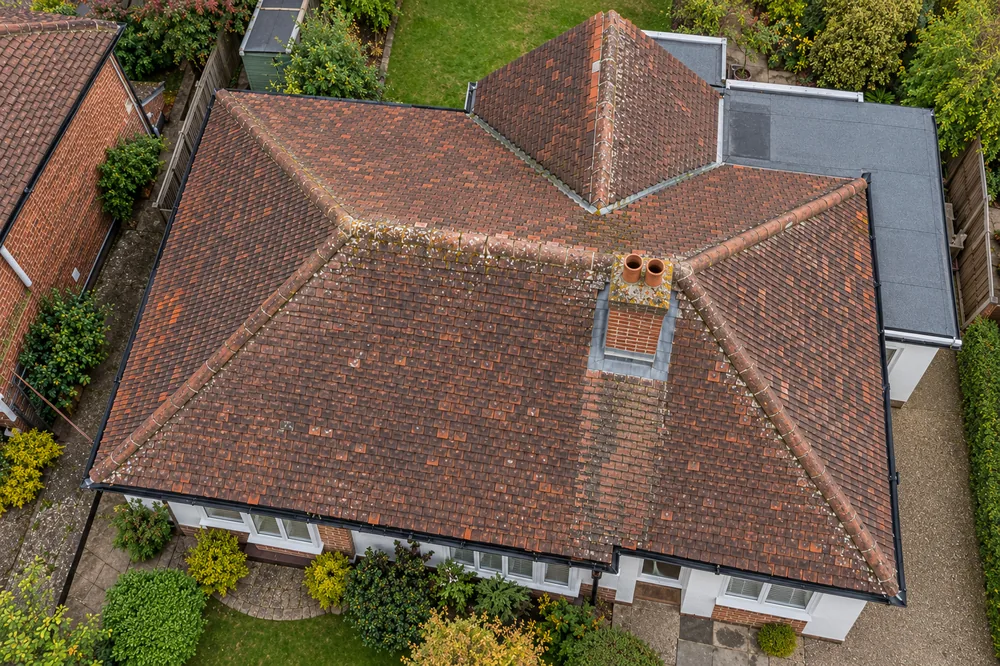
A roof condition report is an independent document describing the condition of every roof element, graded 1 to 3 on a traffic-light scale, with numbered photographs, a costed repair schedule in bands and a remaining-life estimate. Ours covers the roof by drone, the structure from the loft and gutters at ladder height. £299, PDF in 48 hours.
Last reviewed by Matt Novell
What is a roof condition report?
A roof condition report is a factual, dated record of what a roof looks like and how it is performing, element by element, prepared by an inspector who has no interest in whether work follows. It is not a quotation and not a guarantee. It is evidence: photographs, grades, costs and an opinion on remaining life, signed and insured.
The difference between a condition report and a roofer's 'free survey' is purpose. A roofer's survey is the first page of a sales process and it ends with a price for work. A condition report ends with a grade. If the grade is 1, serviceable, the report says so and nothing else happens. Around a third of the roofs we inspect for owners who were told they needed a new roof turn out to need a repair in the £300 to £900 range instead.
Our report runs to 20 to 30 pages. The front page carries the address, date, weather, method, the overall grade and a two-sentence summary. Then a roof plan with every element numbered. Then the element schedule, one entry per slope, chimney, valley, flat roof, gutter run and loft zone, each with a grade, a description, the photograph numbers and a repair band where relevant. Then the costed schedule, the remaining-life estimate, the scope and limitations statement, and the surveyor's signature with professional indemnity details.
Because the structure is fixed, two reports on the same house a year apart can be compared line by line. That is what makes it useful to landlords tracking a portfolio and to sellers who want to show a buyer that nothing has changed since the report was written.
How does the traffic-light grading work?
Every roof element is given one of four grades. Grade 1: serviceable, routine maintenance only. Grade 2: a defect is present and repair is advisable within 12 months. Grade 3: a serious defect, repair before exchange of contracts or within three months. NI: not inspected, with the reason stated. The overall roof grade is the worst element grade.
The grading is deliberately blunt. Buyers, lenders and landlords do not want six pages of nuance about a chimney; they want to know whether it needs doing now, soon or not at all. The description beneath each grade carries the nuance. A Grade 2 on a slope might read 'eleven slipped or cracked concrete interlocking tiles across the rear slope, no evidence of water entry in the loft below, repair within 12 months to prevent felt degradation'.
Grade 3 is reserved for defects that are letting water in now, are likely to within a few months, or present a safety risk. Open lead valleys, missing ridge tiles, a chimney stack leaning past vertical, a flat roof with ponding and splits, rafter feet showing active rot. We do not use Grade 3 to add urgency to a report. If a lender sees a Grade 3 from us it is because something needs fixing.
NI is used freely. A valley hidden under a tree canopy that the drone cannot photograph safely is NI, not Grade 1. The scope statement lists every NI element and why, so a reader knows where the gaps are and can decide whether a second visit with the pole camera is worthwhile.
- Grade 1: serviceable, routine maintenance only
- Grade 2: defect present, repair within 12 months
- Grade 3: serious, repair before exchange or within 3 months
- NI: not inspected, with the reason stated in the scope section
Who uses a roof condition report and why?
Sellers commission one before listing so the roof question is answered before a buyer's surveyor asks it. Landlords use it as a maintenance baseline and compliance record. Owners use it to check a contractor's diagnosis before committing to a re-roof. Policyholders use it after storm damage. Solicitors use it in disputes about work already done.
For sellers, the value is control of the narrative. A buyer's Level 2 surveyor who finds a condition report already in the sales pack, dated within the last six months, with photographs and grades, tends to accept it rather than recommend a further specialist report. That removes one of the most common reasons sales stall at week six. If the report shows Grade 2 items, the seller can fix them or price them in, and the buyer cannot later claim surprise.
For owners weighing a contractor's advice, the report is a second opinion without a sales motive. 'You need a new roof, £11,000' is a sentence we hear repeated to us several times a month. Sometimes it is correct. Often the roof has a decade left and needs £700 of work. The report gives the owner a graded, photographed basis to go back to the contractor, or to get competitive quotes for the work that is actually required.
In disputes, the report records the current state of workmanship: a re-roof where the tiles are not nailed, a flat roof where the GRP has not been taken up the upstand, a chimney re-pointed with a mortar that is already washing out. We describe what is visible and photograph it. We do not act as expert witnesses, but a clear, dated, independent record is often enough to resolve a disagreement before it reaches a solicitor.
What does the loft inspection add to a drone survey?
The drone shows the outside of the covering. The loft shows whether it is working. Staining on rafters, daylight at the eaves, perished felt, condensation on the membrane, insulation blocking ventilation, rot at rafter feet and spray foam are all invisible from above, and they are the findings that most often change a grade from 2 to 3.
We inspect from the hatch and from any boarded walkway, with a high-output torch and a camera. We do not walk on joists, move insulation or shift stored items. In a typical semi-detached loft that gives a clear view of 70 to 90 per cent of the rafters and the underside of the covering. The report records what proportion was visible.
What we are looking for is the history the covering cannot tell. A roof that looks sound from the drone but has tide marks on every rafter below the rear valley has a valley that leaks in driving rain and dries out before anyone notices. A loft where the insulation has been pushed hard into the eaves has no airflow, and the black spotting on the felt is the result. A 1970s roof where the original bitumen felt now tears at a touch has a covering that will need stripping within five years regardless of how the tiles look.
The loft is also where the lender-sensitive findings live: spray foam, chipboard decking over joists that were never designed for storage, and historic woodworm treatment. Each is recorded with photographs so that a buyer or lender reading the report has the whole picture.
How is the repair schedule costed?
Each Grade 2 and Grade 3 item is given a cost band, not a single figure: roof repairs £150 to £900, flat roofs £800 to £6,000, guttering £80 to £2,000, chimneys £150 to £800 or more, full re-roof £4,000 to £15,000. London carries a 15 to 25 per cent uplift. Every band is marked 'budget indication, not a quotation'.
We use bands because we do not price work and do not want anyone to treat our figure as a quote. The band tells you the order of magnitude so you can plan, negotiate or budget. If a contractor quotes well outside the band, that is a prompt to ask why or to get another quote, not proof that either party is wrong. Scaffolding, access and the specific material chosen can move a job within and occasionally beyond a band.
The schedule is split three ways: immediate items, 12-month items and 5-year items. The immediate column is what a lender will retain against and what a buyer will negotiate on. The 12-month column is the maintenance plan. The 5-year column is the long-term budget, and it is where a remaining-life estimate of under five years on the main covering appears as a re-roof band.
Each line in the schedule references the element number on the roof plan and the photograph numbers, so a contractor pricing from the report can see exactly what is meant without a site visit, which usually produces tighter and more comparable quotes.
What does the remaining-life estimate mean?
The remaining-life estimate is our opinion of how many years the main roof covering has before it needs replacement rather than repair, assuming normal maintenance. It is a judgement based on the material, its known service life, its age and the condition observed, and it is given as a range, for example 10 to 15 years.
Typical service lives in southern England are a useful starting point: Welsh slate 80 to 120 years depending on fixings, clay plain tiles 60 to 100 years, concrete interlocking tiles 40 to 60 years, mineral felt flat roofs 10 to 20 years, GRP and EPDM 25 to 40 years. A 1965 concrete tile roof is therefore at or past its design life, and what matters is whether the tiles are delaminating and the battens and felt are intact.
The estimate is deliberately conservative where the loft was only partly visible, and the report says so. We also distinguish the covering from the structure: a 1900 slate roof may need re-slating within five years while the rafters and purlins are good for another century. Lenders read the remaining-life line more closely than any other, because a covering with under five years left is often a retention trigger regardless of the current grade.
If you are a seller, a remaining-life estimate of 15 years or more on an older roof is one of the most valuable sentences you can put in front of a buyer's surveyor.
What does the report cover?
- Front-page summary with overall grade and method statement
- Numbered roof plan with every slope, chimney, valley and flat section
- Element schedule with grade, description and photograph references
- Drone photographs of all coverings, ridges, hips, valleys and flashings
- Chimney stacks including rear faces, flaunching and pots
- Loft inspection: timbers, felt or membrane, insulation, ventilation, staining, spray foam
- Gutters, downpipes, fascias and soffits at ladder height
- Flat roofs to extensions, dormers and garages
- Costed repair schedule in bands: immediate, 12-month, 5-year
- Remaining-life estimate for the main covering
- Scope and limitations statement listing every NI element
- Signed by a named surveyor with professional indemnity details
From booking to report in four steps
Book and pay online
Select the Full Roof Condition Report at /book/. Enter the address and who should be named on the report. Card payment by link, report released on payment.
We confirm a slot
Usually within five working days, often sooner. Loft access needed for 20 minutes; the drone and ladder work are done from outside.
60 to 90 minutes on site
Drone survey of every element, loft from the hatch, gutters and fascias from the ladder. Nothing is walked on, lifted or disturbed.
PDF within 48 hours
Graded, photographed, costed report with remaining-life estimate. 24-hour option £50. Re-inspection after works £99 if you need completion confirmed.
What does a roof survey cost?
Prices include travel within 30 miles of Fleet. Zone 2 adds £40, Zone 3 adds £80. Add thermal leak tracing for £75, a second building for £99, or a 24-hour turnaround for £50. Card payment on booking; the report is released on payment.
Drone Roof Report
Drone survey of every slope, ridge, valley, flashing and chimney. Photographed defect schedule with condition grades. PDF in 48 hours.
Book this reportFull Roof Condition Report
Drone survey plus loft inspection, gutters and fascias, costed repair schedule and remaining-life estimate. Our most-booked report.
Book this reportPre-Purchase Roof Report
Full report plus a one-page lender summary and a 15-minute call to walk you through it before exchange. 24-hour option available.
Book this reportFull breakdown on the roof survey cost page. Questions? Call 01252 447 731.
Report required by your lender or solicitor?
Send us the valuer's wording or the solicitor's request when you book. We address the report to whoever needs it, quote their condition on page one, and answer it directly. Call 01252 447 731 if the mortgage offer has a deadline and we will prioritise the slot.
Other roof surveys we carry out
Pre-Purchase Roof Survey
A pre-purchase roof survey is an independent inspection of a house you are buying, carried out before exchange of contracts.
Read moreRoof Survey for Mortgage
A roof survey for mortgage purposes is an independent inspection ordered because the lender's valuer has flagged the roof.
Read moreRoof Condition Report
A roof condition report is an independent document describing the condition of every roof element, graded 1 to 3 on a traffic-light scale, with numbered photographs, a costed repair schedule in bands and a remaining-life estimate.
Read moreDrone Roof Survey
A drone roof survey is a close-range photographic inspection of a roof from the air by a CAA-registered operator.
Read moreRoof Insurance Claim Report
A roof insurance claim report is an independent, photographed record of roof damage prepared to support a buildings insurance claim.
Read moreSpray Foam Roof Inspection
A spray foam roof inspection records the type of foam applied under a roof, open or closed cell, the proportion covered, whether the rafters and felt beneath can be inspected, evidence of damp or decay, and ventilation.
Read moreLandlord Roof Inspection
A landlord roof inspection is an independent, graded condition report on a rented property's roof, loft and gutters, used to evidence compliance with Section 11 of the Landlord and Tenant Act 1985 and the Homes (Fitness for Human Habitation) Act 2018, to plan maintenance and to answer tenant damp reports.
Read moreRoof Leak Detection Survey
A roof leak detection survey traces water entry from the ceiling stain back to the external defect.
Read morePre-Solar Roof Survey
A pre-solar roof survey assesses whether a roof is fit to carry solar panels for their 25-year life.
Read moreRelated guides
How long does a roof last?
Typical lifespans for every common roof covering, and the signs that yours is running out.
Read the guideA roofer says I need a new roof. Do I?
How to test a recommendation for a new roof before you spend five figures on it.
Read the guideSagging roof: when should I worry?
Why rooflines dip, how to tell old settlement from active movement, and who should look at it.
Read the guideRoof Condition Report questions
In our usage, yes. The survey is the inspection and the condition report is the document it produces. Some firms use 'survey' for a quick look and 'report' for a written document; we always issue a written, graded, photographed report, so the terms are interchangeable. It is never a structural survey, which is an engineer's product.
The report records condition on the inspection date. Buyers' surveyors and lenders generally treat it as current for six months unless there has been a storm or works in between. For landlords we suggest re-inspection every three to five years on pitched roofs and two to three on flat roofs, plus a drone check after any named storm.
Yes, and we encourage it. Send contractors the element schedule and the photographs. They can price from the report without a visit, and because each item is numbered and photographed, the quotes you receive are for the same work and can be compared. Contractors tell us it reduces their time and produces fewer surprises on site.
Yes. For a single flat we report on the whole roof and identify the parts relevant to the flat and the common structure. For a block, the managing agent usually instructs us; we need their consent to fly and to use any roof hatch. Blocks over four storeys sometimes need the pole camera, which we discuss at booking.
We complete the drone and external inspection and record the loft as NI with the reason. The report is still issued, at the drone report price of £199 rather than £299, and we return for the loft within three months for the £100 difference plus any travel charge. Lenders usually accept a report with an NI loft and a note.
Yes. We are paid for the inspection, not for findings. A report of all Grade 1 elements with a remaining-life estimate and a note of routine maintenance is a common and useful outcome, especially for sellers and for owners who have been told by a contractor that a re-roof is needed.
Yes. Tell us at booking and the report is addressed accordingly, with you copied. We can also address it to a named insurer, lender or freeholder. Re-addressing after issue is free within three months provided there have been no works or storms in between.
A free survey is a quote. It is paid for by the work that follows and tends to find that work. Our report is paid for by you, finds only what is there, and is signed, insured and written to a format a lender or buyer can rely on. Owners quoted a £9,000 re-roof who needed a £450 repair understand.
Where we carry out roof surveys
Based in Fleet, Hampshire, covering a 90-mile radius in three travel zones. Every town below has its own page with local housing stock, what valuers flag there and drone access notes.
Why not just ask a roofer?
A roofer looks at a roof to price the work they would like to do on it. That is not dishonesty, it is the job. An independent report has no work attached: every finding is graded against a fixed scale, photographed, and costed in bands so you can take it to any contractor, lender or insurer. We never quote for repairs and we have no referral arrangement with anyone who does.
If the report does find work, you choose the roofer. We will tell you what a fair price band looks like for each item, which is often the most valuable page in the document.
Based in Fleet, Hampshire · covering Hampshire, Surrey, Berkshire, Sussex and the South
Phone: 01252 447 731
Email: info@southernroofsurveys.co.uk
Hours: Mon–Fri 8am–6pm · Sat 8am–1pm
Reports: PDF within 48 hours of inspection
Book your roof condition report
Fixed price, independent, PI insured, report in 48 hours. Book online in two minutes or call to talk it through first.
01252 447 731