Roof Leak Detection Survey Find Where the Water Gets In
The stain on the landing ceiling comes back every time the wind is from the south-west, and two roofers have each fixed something different. The leak is still there. A leak detection survey works from the inside out: the loft shows where water arrives, the drone shows what is above that point, and thermal imaging shows how far the wet has spread.
Roof Leak Detection Survey explained
A roof leak detection survey traces water entry from the ceiling stain back to the external defect. It combines a loft inspection to find the arrival point, a drone survey of the roof above it, and optional thermal imaging to map moisture in ceilings and insulation. It separates ingress from condensation and plumbing. £299 plus £75 for thermal, 48 hours.
Last reviewed by Matt Novell
Why can nobody find where my roof is leaking?
Because water rarely comes through the ceiling directly below where it enters the roof. It runs along the felt, down a rafter, across a purlin, and drips off a nail or joist edge a metre or more from the entry point. Roofers working from a ladder outside guess at the slope above the stain and fix whatever looks worst there.
Intermittent leaks are the hardest. A valley that only overflows in a south-westerly gale, a chimney back gutter that only fills when the rain is heavy and prolonged, a lead flashing that lets water in when it is driven horizontally and never otherwise. On a dry day, none of those shows any sign of water. The roofer sees a slipped tile nearby, replaces it, and the leak returns in the next storm.
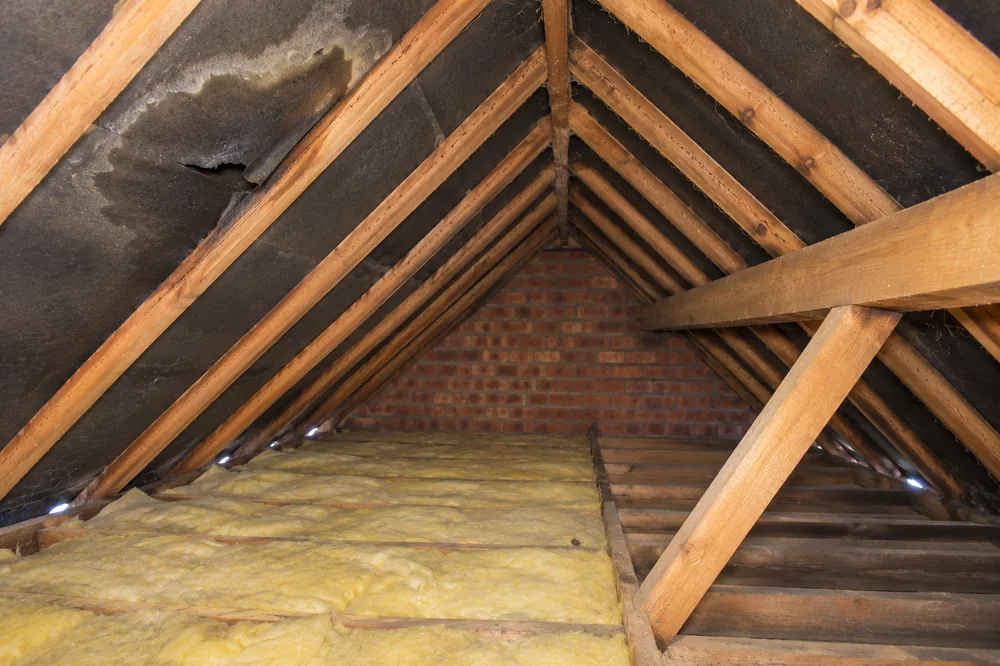
The method that works is to start in the loft. Water leaves a trail: tide marks on the felt, a dark streak down the side of a rafter, a stain on the top of the ceiling insulation. Following that trail upwards and sideways reaches the point where the water first appears on the underside of the roof, and that point is directly below the defect. We mark it, measure its position from the gable or the hatch, and then find the same position on the drone photographs.
The report gives the entry point, the external defect at that position, the reason it leaks only in certain conditions, and the repair band. Fixing the right thing once is cheaper than fixing the wrong thing three times.
Is it a leak or is it condensation?
About a third of suspected roof leaks we investigate are condensation. The signs differ. Condensation produces uniform dark spotting across the felt, droplets on nail points in cold weather, damp insulation over a wide area and mould in ceiling corners, worst in winter and absent in summer. A leak produces a localised stain with a trail to a specific point.
Condensation in lofts has become more common since loft insulation was topped up to 270mm or more under energy schemes. The thicker insulation makes the loft colder, warm moist air from the house rises through the ceiling and hatch, meets the cold felt and condenses. If the eaves ventilation has been blocked by the new insulation, there is no air movement to carry the moisture away, and it rains inside the loft on cold mornings.
Bathroom and kitchen extractors ducted into the loft rather than to the outside are the other common cause, and tumble dryers vented into the roof space. We check every duct we can see from the hatch and record where it terminates.
The fix for condensation is ventilation and sealing the ceiling, typically £80 to £400, not roof repair. The report says which you have, with photographs, so you do not spend £900 on a roofer when a £150 vent would have fixed it, or the reverse.
- Localised stain with a trail along felt or rafter: ingress
- Uniform spotting on felt, droplets on nails, wet insulation everywhere: condensation
- Stain under a bathroom or pipe run with dry timber above: plumbing
- Stain on an external wall below the gutter line: overflowing gutter or failed pointing
- Stain at a chimney breast: usually flashing, back gutter or porous brickwork
What does thermal imaging add to leak detection?
Thermal imaging shows the extent of moisture in ceilings, insulation and walls by detecting the cooler temperature of wet material. It maps how far water has spread from the entry point and reveals wet areas that have not yet stained. It does not see through the roof or find the external defect. It is a £75 add-on.
The camera is most useful inside the house, from below. A ceiling that shows a 20cm stain may show a wet area of a square metre in the thermal image, which tells you whether the plasterboard will need replacing or just redecorating once the leak is stopped. In the loft, a thermal image of the insulation shows the wet patch and its shape, which often points to the direction the water travelled from.
Thermal imaging has limits that we state in the report. It needs a temperature difference, so it works best in the evening or early morning and poorly on a warm, still day after a dry week. It cannot distinguish wet from cold, so a wet patch and a draught from a gap in the insulation can look similar, and we confirm with a moisture meter. It cannot see through tiles, so it does not replace the drone.
For flat roofs, thermal imaging from the drone at dusk can show trapped water under the covering as a warm area, because wet insulation holds the day's heat longer than dry. That is useful for deciding whether a felt or GRP roof can be patched or must be replaced, and it is the one case where thermal from above adds something the daytime drone cannot see.
Which parts of the roof leak most often?
Valleys, chimney flashings and back gutters, abutment flashings where a roof meets a wall, and flat roof upstands and outlets, in that order. Slipped tiles on the open slope are a distant fifth, because a single slipped tile usually lets water onto the felt, which carries it to the gutter. Junctions leak; plain slopes rarely do.
Valleys fail because they carry the water from two slopes and they are where leaves, moss and debris collect. A lead valley that has cracked along its fold, a GRP valley with a split, or a mortar-bedded tile valley where the bedding has washed out will all overflow under the tiles in heavy rain. Valleys are also hard to see from the ground and from a ladder, and the drone photograph straight down the valley is often the first time anyone has looked at it properly.
Chimneys leak at the back gutter, the lead tray behind the stack that catches the water running down the slope above, and at the step flashings down the sides. On older houses the lead is thin, the mortar it is chased into has failed, and the stack itself may be porous enough to let water through the brickwork into the loft. The report photographs all four faces and the top of the stack and states which is the likely path.
Flat roofs leak at the edges: the upstand where the covering turns up against a wall, the drip edge at the gutter, and the outlet. The middle of a flat roof rarely leaks unless it has split. The drone photograph shows ponding, which indicates a sag or a blocked outlet, and the upstand condition, which the ladder cannot see.
What should I do before the survey?
Note when the leak appears: which weather, which wind direction, how long into the rain, and whether it stops when the rain stops. Photograph the stain each time. Do not redecorate or replace plasterboard before the survey. If a roofer has already done work, keep their invoice and ask what they replaced. Clear a path to the hatch.
The weather pattern is often diagnostic on its own. A leak that appears within minutes of heavy rain is a direct path: a hole, a missing tile, an open valley. A leak that appears an hour or more into prolonged rain is a capacity problem: a back gutter or valley that fills and overflows, or brickwork that saturates. A leak only in wind-driven rain from one direction is a flashing or an exposed edge on that side. We ask for this at booking and it directs the inspection.
If the leak is active when we attend, that is the easiest case: we see the water arriving in the loft. If you can book us for a wet day, do. Otherwise we rely on the stains and the thermal image, which is still reliable in most cases because water leaves a record.
Where the roof has been patched repeatedly, the report records each patch and comments on whether it addressed a real defect. Owners sometimes find that three roofers have fixed three different things, none of them the leak, and the report ends that cycle.
What does the leak detection report give me?
The entry point marked on the roof plan and photographed in the loft, the external defect at that position photographed by drone, the cause and the reason it is intermittent, any contributing condensation or plumbing issues, the extent of moisture from thermal imaging if taken, and a repair band. Plus the full graded condition of the rest of the roof.
The report is written to hand to a roofer. The element number, the photograph and the description tell the contractor exactly what to repair and where. 'Replace the lead back gutter to the rear chimney, element C2, photographs 14 to 17, and re-point the chase. Band £150 to £450.' A roofer pricing that knows the job. A roofer pricing 'fix the leak over the landing' does not.
Because the whole roof is graded, you also learn whether the leak is a one-off defect on a sound roof or the first symptom of a covering that is failing generally. On a 1960s concrete tile roof with porous, delaminating tiles, a leak at a valley may be the first of several, and the report says so with a remaining-life estimate so you can decide whether to repair or plan a re-roof.
After the repair, the £99 re-inspection confirms it was done and photographs the element from the same position. If the leak returns anyway, the record shows what was done and when, which is the evidence you need to go back to the contractor.
What does the report cover?
- Loft inspection to locate the water arrival point and trace the trail
- Entry point measured and marked on the roof plan
- Drone photographs of the roof above the entry point at close range
- Identification of the external defect and the reason it leaks intermittently
- Ingress, condensation or plumbing determination with photographs
- Extractor and duct termination check in the loft
- Ventilation and insulation assessment where condensation is suspected
- Thermal imaging of ceilings, walls and insulation (add-on, £75)
- Moisture meter readings at stained timber and plaster
- Repair band for the defect, written so a contractor can price it
- Full graded condition report for the rest of the roof
- Re-inspection after repair at £99
From booking to report in four steps
Book with the leak history
At /book/, choose the Full Roof Condition Report and add thermal imaging if you want the moisture extent mapped. Tell us when the leak appears and in what weather.
Inside first, then above
We trace the trail in the loft to the entry point, measure its position, then fly the drone over that position and the rest of the roof. 60 to 90 minutes.
Report in 48 hours
Entry point, external defect, cause, repair band, thermal images and the full graded roof condition. Written so a roofer can price the exact job.
Repair and confirm
Give the report to your chosen roofer. After the work, book the £99 re-inspection to confirm the defect is fixed and close the record.
What does a roof survey cost?
Prices include travel within 30 miles of Fleet. Zone 2 adds £40, Zone 3 adds £80. Add thermal leak tracing for £75, a second building for £99, or a 24-hour turnaround for £50. Card payment on booking; the report is released on payment.
Drone Roof Report
Drone survey of every slope, ridge, valley, flashing and chimney. Photographed defect schedule with condition grades. PDF in 48 hours.
Book this reportFull Roof Condition Report
Drone survey plus loft inspection, gutters and fascias, costed repair schedule and remaining-life estimate. Our most-booked report.
Book this reportPre-Purchase Roof Report
Full report plus a one-page lender summary and a 15-minute call to walk you through it before exchange. 24-hour option available.
Book this reportFull breakdown on the roof survey cost page. Questions? Call 01252 447 731.
Report required by your lender or solicitor?
Send us the valuer's wording or the solicitor's request when you book. We address the report to whoever needs it, quote their condition on page one, and answer it directly. Call 01252 447 731 if the mortgage offer has a deadline and we will prioritise the slot.
Other roof surveys we carry out
Pre-Purchase Roof Survey
A pre-purchase roof survey is an independent inspection of a house you are buying, carried out before exchange of contracts.
Read moreRoof Survey for Mortgage
A roof survey for mortgage purposes is an independent inspection ordered because the lender's valuer has flagged the roof.
Read moreRoof Condition Report
A roof condition report is an independent document describing the condition of every roof element, graded 1 to 3 on a traffic-light scale, with numbered photographs, a costed repair schedule in bands and a remaining-life estimate.
Read moreDrone Roof Survey
A drone roof survey is a close-range photographic inspection of a roof from the air by a CAA-registered operator.
Read moreRoof Insurance Claim Report
A roof insurance claim report is an independent, photographed record of roof damage prepared to support a buildings insurance claim.
Read moreSpray Foam Roof Inspection
A spray foam roof inspection records the type of foam applied under a roof, open or closed cell, the proportion covered, whether the rafters and felt beneath can be inspected, evidence of damp or decay, and ventilation.
Read moreLandlord Roof Inspection
A landlord roof inspection is an independent, graded condition report on a rented property's roof, loft and gutters, used to evidence compliance with Section 11 of the Landlord and Tenant Act 1985 and the Homes (Fitness for Human Habitation) Act 2018, to plan maintenance and to answer tenant damp reports.
Read moreRoof Leak Detection Survey
A roof leak detection survey traces water entry from the ceiling stain back to the external defect.
Read morePre-Solar Roof Survey
A pre-solar roof survey assesses whether a roof is fit to carry solar panels for their 25-year life.
Read moreRoof Leak Detection Survey questions
Usually, yes. Intermittent leaks leave stains in the loft that lead to the entry point even when dry. The weather pattern you describe, such as wind direction or how long into the rain it starts, tells us whether to look at a flashing, a valley capacity problem or saturated brickwork. If you can book a wet day, better still.
If you need to know how far the water has spread, for example to decide whether to replace plasterboard or insulation, or to show an insurer the extent, yes. If you only need the entry point and the external defect, the loft and drone usually find it without thermal. We will advise at booking from your description.
No. We carry out no repairs and have no relationship with contractors. The report identifies the defect precisely enough for any roofer to price and repair it, and the £99 re-inspection confirms afterwards that it was done. That separation is why the diagnosis is reliable: we are not paid more for finding bigger problems.
Because we start in the loft and work outwards rather than looking at the outside and guessing. Water travels along felt and rafters before it drips, so the ceiling stain is rarely below the defect. Most repeat leaks we see were repaired at the wrong place. The report shows the actual entry point and photographs the defect above it.
In about one in three cases, yes. Condensation shows as uniform spotting on the felt, wet insulation over a wide area and mould in ceiling corners, worst in winter. The loft inspection distinguishes it from ingress and the report gives the ventilation fix, typically £80 to £400, instead of a roof repair that would not have helped.
Yes. Flat roofs leak at upstands, outlets and drip edges, all of which the drone photographs from above and the ladder sees from the side. Thermal imaging at dusk can show trapped water under the covering as a warm patch. The report states whether the roof can be patched or needs replacing, with a band from £800 to £6,000.
Chimneys are the second most common source after valleys. We orbit the stack with the drone to photograph the back gutter, step flashings, flaunching, pots and brickwork, and inspect the chimney breast in the loft for staining. The report states whether the path is the lead, the mortar or porous brick, each of which has a different repair and band.
Yes. The leak detection survey is the Full Roof Condition Report with the leak trace as its focus. Every element is graded and photographed and you receive the costed schedule and remaining-life estimate. That tells you whether the leak is an isolated defect or the first sign of a covering that is reaching the end of its life.
Where we carry out roof surveys
Based in Fleet, Hampshire, covering a 90-mile radius in three travel zones. Every town below has its own page with local housing stock, what valuers flag there and drone access notes.
Why not just ask a roofer?
A roofer looks at a roof to price the work they would like to do on it. That is not dishonesty, it is the job. An independent report has no work attached: every finding is graded against a fixed scale, photographed, and costed in bands so you can take it to any contractor, lender or insurer. We never quote for repairs and we have no referral arrangement with anyone who does.
If the report does find work, you choose the roofer. We will tell you what a fair price band looks like for each item, which is often the most valuable page in the document.
Based in Fleet, Hampshire · covering Hampshire, Surrey, Berkshire, Sussex and the South
Phone: 01252 447 731
Email: info@southernroofsurveys.co.uk
Hours: Mon–Fri 8am–6pm · Sat 8am–1pm
Reports: PDF within 48 hours of inspection
Book your roof leak detection survey
Fixed price, independent, PI insured, report in 48 hours. Book online in two minutes or call to talk it through first.
01252 447 731