Flat roof flagged on a survey: what should I check?
Why flat roofs draw comment on surveys, how long each type lasts and what an inspection looks at.
 1234
Surveyors flag flat roofs because their coverings have a shorter life than pitched roofs and their age is usually unknown. Find out what the covering is, how old it is and whether it is ponding or leaking. A close inspection from above identifies the material, grades its condition and estimates the years left, which is normally all a lender needs.
Last reviewed by Matt Novell
Why do surveyors and lenders worry about flat roofs?
Because a flat roof has less margin for error. Water drains slowly, every joint is a potential leak, and the covering is exposed to full sun.
A surveyor at ground level usually cannot see the surface at all, so they cannot say how old it is or what condition it is in. The standard response is a line in the report saying the flat roof has a limited life and should be inspected.
Some lenders and insurers also ask what proportion of the roof is flat. A small extension roof rarely troubles them. A house that is mostly flat-roofed gets closer attention.
How long does each type last?
The material makes a large difference, and so does the quality of the detailing at edges and upstands.
- Older built-up felt, often with stone chippings: 10 to 20 years. Most of what is failing now.
- Modern torch-on felt: 20 to 30 years.
- EPDM rubber, a single black sheet: 25 years or more.
- GRP fibreglass, a hard seamless surface: 20 to 30 years.
- Single-ply membrane, common on newer buildings: 20 to 30 years.
- Lead or zinc sheet, on older and higher-quality buildings: 60 years or more.
What does an inspection check?
The whole surface, seen from directly above, and what is happening underneath it.
- The covering type, and whether it has been overlaid on an older one.
- Blisters, cracks, splits and open laps.
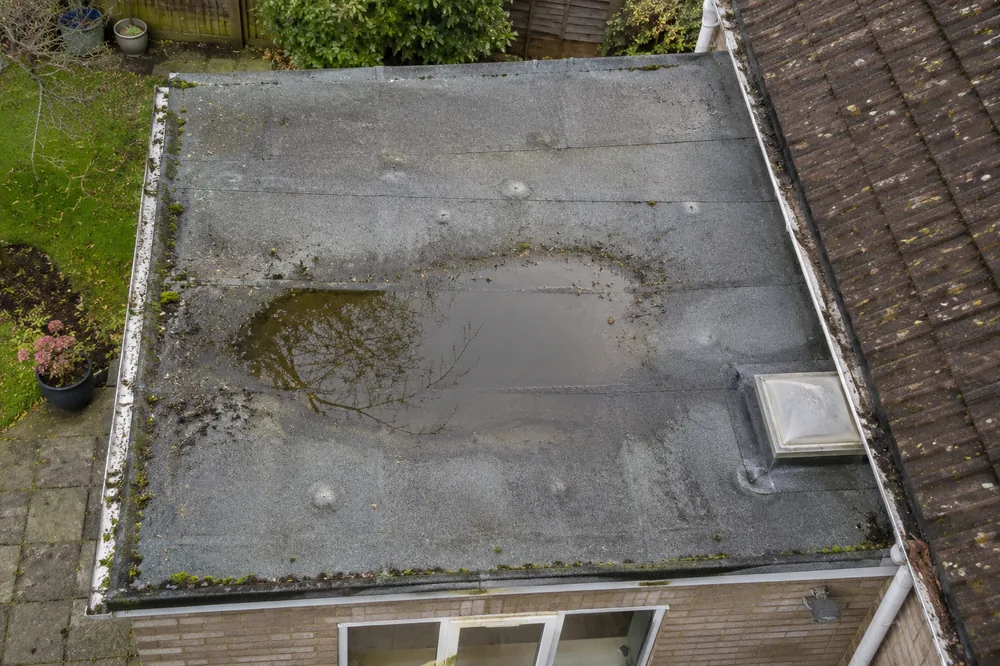
- Ponding: water or tide marks showing where it stands after rain.
- Upstands and flashings where the roof meets walls, and the height of those upstands.
- Outlets and gutters: clear, blocked or missing.
- The edges: drips, trims and fascia.
- Sagging in the deck between joists.
- Inside: staining on the ceiling below, and ventilation where it is a cold roof.
A drone photographs the surface in detail without anyone walking on it, which matters on an old roof that foot traffic could damage.
Does ponding mean the roof has failed?
Not on its own. Many flat roofs hold shallow puddles after rain, and a sound membrane will tolerate it.
It does shorten the life of the covering and it suggests the falls are inadequate or the deck has sagged. Water that is still standing two days after rain is worth recording. Combined with blistering, cracks or staining below, it points to a roof near the end.
When a ponding roof is replaced, the falls should be corrected at the same time, usually with tapered insulation or firring strips.
What should I do if one is flagged?
Get the facts, then treat it as a budgeting item.
- Ask the seller when it was last replaced, with what, and for any guarantee.
- Have it inspected from above before exchange.
- If it has years left, send the report to your lender and solicitor and proceed.
- If it is at the end, get a replacement price and negotiate. Replacing a domestic flat roof typically costs £800 to £6,000 depending on area and material.
- Check whether the replacement will need building control approval; upgrading insulation is usually required when a flat roof is renewed.
Pre-Purchase Roof Survey
A pre-purchase roof survey is an independent inspection of a house you are buying, carried out before exchange of contracts.
Sample report
Nine pages, fictional property: summary, lender page, graded findings and costs.
Common questions
Rarely on its own. A flat roof over an extension or garage usually draws a comment and nothing more. Lenders look harder when most of the roof is flat or the covering has visibly failed. A report with the covering type, condition and remaining life answers the query.
Felt has visible overlapping strips and often a mineral or chipping finish. EPDM is a smooth black rubber sheet. GRP is hard, seamless and usually grey. If you cannot see the surface, an inspection will identify it.
It can. Insurers often ask what percentage of the roof is flat and may apply terms above a threshold. Answer accurately; a report gives you the figure.
Local defects in a sound covering, such as an open lap or a failed flashing, can be repaired. Widespread blistering, cracking or saturation of the deck means replacement. Overlaying an old roof with a new layer hides problems and is a short-term fix.
More guides
Survey says the roof needs further investigation
What the wording on a Level 2 survey or valuation means, and the four steps that follow.
Read the guideMortgage retention for roof repairs
Why a lender holds money back for a roof, how the figure is set and how to get it released.
Read the guideCan you get a mortgage on a house with spray foam insulation?
Why lenders are wary of spray foam in a roof, and what buyers and sellers can do about it.
Read the guideWant the roof checked properly?
Independent inspection, graded report in 48 hours, no repairs sold.
01252 447 731