Can you get a mortgage on a house with spray foam insulation?
Why lenders are wary of spray foam in a roof, and what buyers and sellers can do about it.
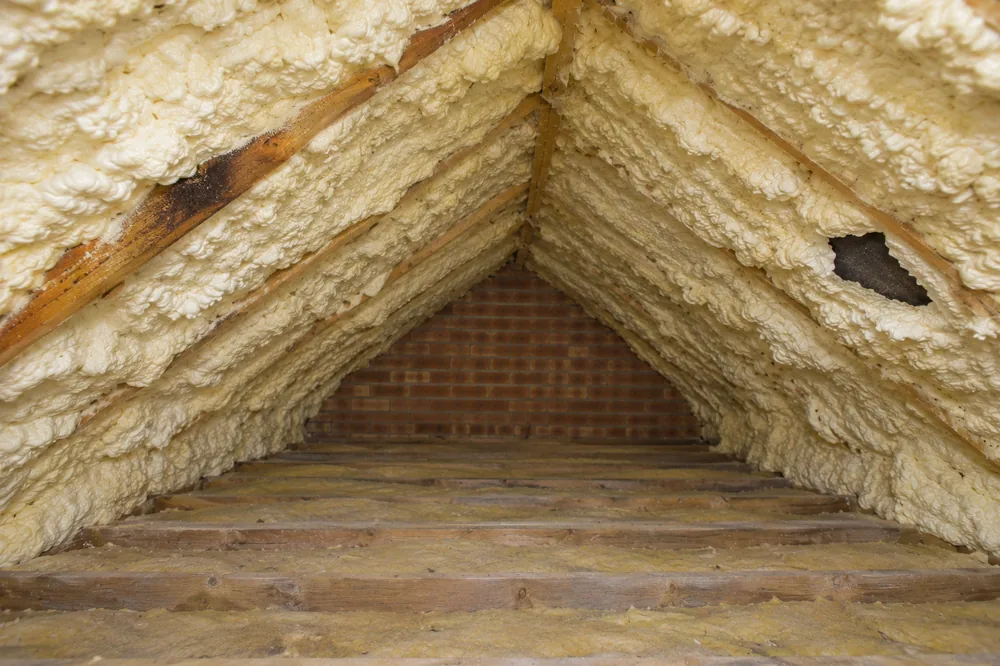
Sometimes. Lender policies on spray foam roof insulation vary: some decline, some lend after a satisfactory specialist report, and some require the foam to be removed. The concern is that foam hides the roof timbers and can trap moisture. An independent inspection establishes the foam type, the moisture levels and the visible condition, which is the evidence a lender will ask for.
Last reviewed by Matt Novell
Why are lenders cautious about spray foam?
Because it stops anyone seeing the roof. Foam sprayed onto the underside of the tiles covers the felt, the battens and much of each rafter, so neither a valuer nor a surveyor can confirm the timber is sound.
There is also a moisture question. A traditional loft is ventilated, and damp air escapes at the eaves and ridge. Foam applied to the roof slope can block that airflow. If moisture then builds up against the timber, decay can start where nobody can see it.
RICS published a consumer guide on spray foam for these reasons, advising that homeowners use independent experts with no commercial link to the installer or manufacturer.
Open-cell or closed-cell: does it matter?
Yes. They behave differently, and lenders and surveyors treat them differently.
- Open-cell foam is soft and spongy and can be pressed with a finger. It lets water vapour pass through. It still hides the timbers.
- Closed-cell foam sets hard and dense. It does not let vapour through, and it bonds tiles, battens and rafters together, which makes later repair or re-roofing harder.
- Closed-cell foam sprayed directly onto the underside of tiles or slates is the combination that concerns lenders most.
What can an inspection show, and what can it not?
An inspection can identify the foam, measure moisture and record what is visible. It cannot see through the foam.
We record the foam type, where it has been applied and how thickly, whether it runs into the eaves and blocks ventilation, and what it was sprayed onto. We take moisture readings in the exposed timber at several points, look for staining, and photograph the roof covering from outside by drone.
What we cannot do is confirm the condition of timber that is buried. The report says so plainly. Any inspector who claims otherwise without removing foam is guessing. The Property Care Association and the Residential Property Surveyors Association have published an inspection protocol for this work, and our reports follow its approach.
What are my options if I am buying?
Find out the lender's position first, then get evidence.
- Ask your broker whether your lender lends on properties with spray foam, and on what conditions.
- Ask the seller for the installation paperwork: installer, product, date, and any guarantee.
- Commission an independent inspection and send the report to the lender.
- If the lender requires removal, get removal and re-insulation priced and negotiate that sum off the price.
- If the lender will not proceed, a broker may know one that will, on the strength of a report.
What if I am selling a house with spray foam?
Deal with it before a buyer's valuer finds it. A sale that collapses at valuation costs more time than a report does.
Get an independent inspection so you know what you have. If the report is favourable, give it to the agent to share with buyers. If it shows high moisture or blocked ventilation, you can decide whether to remove the foam before marketing.
Removal is specialist work and typically costs thousands of pounds, more where closed-cell foam has bonded to the tiles and the roof covering has to come off with it. Be careful of firms that cold-call offering removal: the same RICS advice about independence applies.
Spray Foam Roof Inspection
A spray foam roof inspection records the type of foam applied under a roof, open or closed cell, the proportion covered, whether the rafters and felt beneath can be inspected, evidence of damp or decay, and ventilation.
Sample report
Nine pages, fictional property: summary, lender page, graded findings and costs.
Sources and further reading
- RICS consumer guide: spray foam insulation explains why surveyors and lenders ask for an independent inspection.
- Property Care Association: sprayed foam inspection protocol the inspection process agreed by a working group of surveyors, lenders and the insulation industry.
External pages are published by the bodies named and were checked when this page was last reviewed.
Common questions
No. Policies vary and they change. Some decline, some lend with a satisfactory specialist report, and some ask for removal. Check with your broker or the lender before you spend money on anything else.
No report can. It gives the lender the evidence they ask for: foam type, extent, moisture readings and visible condition, written by someone independent of installers and removal firms. The lending decision is the lender's.
Press it. Open-cell foam is soft and compresses like a sponge. Closed-cell foam is hard and does not give. The installation paperwork should also name the product. Our inspection confirms the type.
Not before you know what the lender wants. Removal is expensive and some lenders accept a favourable report instead. Get the inspection first, then decide with the facts.
More guides
Roof survey, Level 2 or Level 3: which covers what?
What a home survey sees of the roof, what it misses, and when you need a separate roof report.
Read the guideHow long does a roof last?
Typical lifespans for every common roof covering, and the signs that yours is running out.
Read the guideSlate roof replaced with concrete tiles: is it a problem?
Why heavier tiles on a Victorian roof worry valuers, and how to tell if the structure is coping.
Read the guideWant the roof checked properly?
Independent inspection, graded report in 48 hours, no repairs sold.
01252 447 731